Indezine Logo


Save and Save As Tabs of Backstage View in PowerPoint 2016 for Windows

Explore saving options in Backstage view of PowerPoint 2016 for Windows. You can save existing files or save to a new file name, location, or file type.


Author:

Product/Version: PowerPoint 2016 for Windows

OS: Microsoft Windows 7 and higher


When you click the File menu and access Backstage view in PowerPoint 2016 for Windows, you see several options.

In this tutorial, we explore two of these options, as shown in Figure 1, below:

Save
Save As
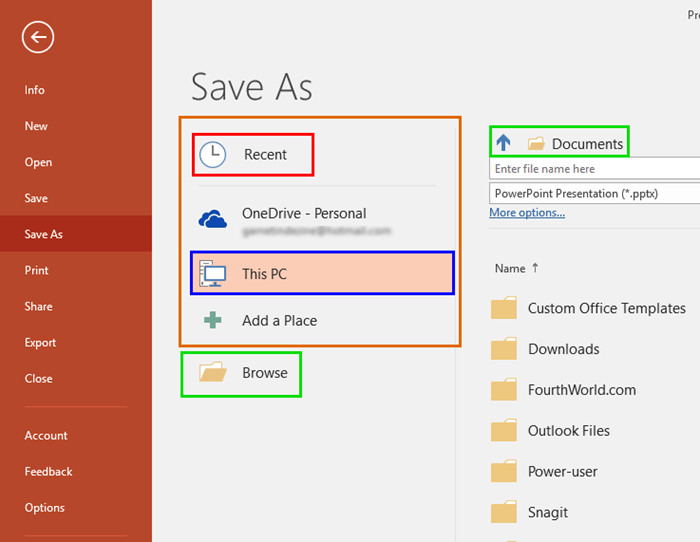
Save and Save As options
Figure 1: Save and Save As options

The Save option works differently depending on whether you are working with a new presentation or a presentation that has already been saved earlier:
  1. When you choose File | Save option for a hitherto unsaved presentation, initially you will see the Recent tab selected, as shown highlighted in red within Figure 1, above. Notice the area highlighted in orange; you can choose any location within this area to save the file. Select This PC option, as shown highlighted in blue within Figure 1. Now, you can choose to save in one of your document folders, listed below the Documents option, or you can alternatively click the Browse option or the Documents option (highlighted in green) to choose any other folder to save in.
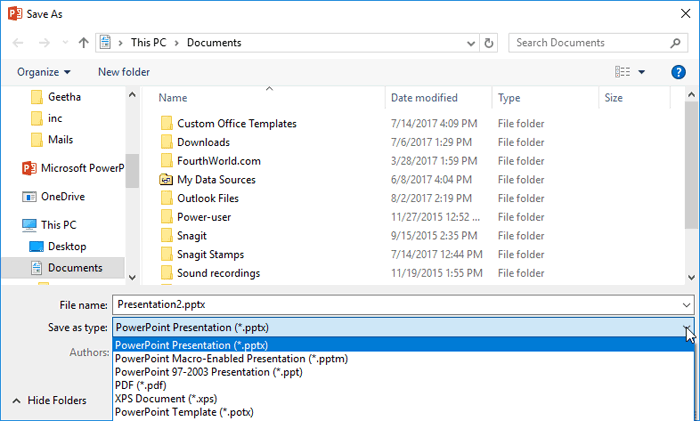
  2. When you click the Browse option or the Documents option, you will end up with the Save As dialog, as shown in Figure 2, below. Navigate to your save location and provide a name for your presentation. In addition, you can also opt to save as different file types that PowerPoint supports. The default File save type is PPTX (PowerPoint Presentation), but there are several other formats you can choose from.
  3. Save As dialog in PowerPoint 2016
    Figure 2: Save As dialog in PowerPoint 2016
  4. When you select the File | Save option for a file that has been previously saved, you'll not be presented with any dialog box, PowerPoint just overwrites your old file with any new changes made since the last save.
  5. File Location for Save

  6. Options for choosing a location, providing a file name, and selecting a file type are provided only when you save the newly created presentation for the first time. Hereafter, the Save option just saves all changes made since the presentation was last saved. If you want to save as a new file, choose the Save As option that we'll discuss next.
  7. When you choose the File | Save As option for a presentation, it doesn’t matter if the file has been previously saved or not, you always end up summoning the Save As dialog box, as shown in Figure 2, previously on this page.

See Also:

01 08 09 - File Types, File Menu, and Backstage View: Save and Save As Tabs of Backstage View in PowerPoint (Glossary Page)

Save and Save As Tabs of Backstage View in PowerPoint 365 for Windows
Save and Save As Tabs of Backstage View in PowerPoint 365 for Mac
Save and Save As Tabs of Backstage View in PowerPoint 2019 for Windows
Save and Save As Tabs of Backstage View in PowerPoint 2013 for Windows
Save and Save As Tabs of Backstage View in PowerPoint 2010 for Windows

You May Also Like: Can You Send Me the Deck? | Rectangles PowerPoint Templates


Popular Posts

10 Tips for Pecha Kucha
Read 10 amazing Pecha Kucha tips that will help you create and deliver a better Pecha Kucha presentation.

Creating Slide Backgrounds in Photoshop for PowerPoint
Learn how to create slide backgrounds for PowerPoint in Photoshop.

Formatting Arrows (Arrowheads) in PowerPoint 2016 for Windows
Learn how to format arrowheads for lines in PowerPoint 2016 for Windows.

Creating Semi-Circles in PowerPoint 2013
Learn how to create a semi-circle in PowerPoint 2013.


Pictures in Presentations

Is a picture is worth a thousand words? You probably have heard this adage so often that we decided not to repeat this phrase throughout this book! Now here’s some more info: the human brain uses a larger part of its area to store visual information rather than textual content. And that’s possibly because a picture describes so much more than text.

Go and get a copy of our Pictures in Presentations ebook.


Microsoft and the Office logo are trademarks or registered trademarks of Microsoft Corporation in the United States and/or other countries.

Home | PowerPoint | Photoshop | PowerPoint Templates | PowerPoint Tutorials | Blog | Notes | Ezine | Media Kit | Feedback | Site Map | About Us | Contact Us

Link to Us | Privacy | Testimonials

PowerPoint Backgrounds | Christian PowerPoint Backgrounds | Business PowerPoint Presentation Templates

Plagiarism will be detected by Copyscape

©2000-2026, . All rights reserved.