This is the print version of this page. All content is copyright Indezine.com 2000-2026.
Learn about the Quick Access Toolbar in PowerPoint 365 for Windows. Once you get used to the Quick Access Toolbar, you may no longer want to function without it.
Author: Geetesh Bajaj
Product/Version: PowerPoint 365 for Windows
OS: Microsoft Windows 10 and higher
Soon after power users install a new application, they want to customize their menus and toolbars so that their most often used commands are accessible with fewer clicks, or even custom keyboard shortcuts. And even if you are not a power user, you should explore a very useful option that we explain in this tutorial, this will make your tasks easier, and quicker.
PowerPoint has no toolbars other than the Quick Access Toolbar. Almost everyone who uses this toolbar just calls it the QAT, and that's the name we will use for the rest of this tutorial. The QAT's raison d'être is customization, and accessing all your favorite commands in one place. It's important to note that the QAT does not add new commands, it just places your favorite commands in one place.
By default, the QAT can be found right above the File tab and the rest of the Ribbon tabs, as shown highlighted in green within Figure 1. Also, the default commands you can find within QAT are Save, Undo, Redo, and Start from Beginning. You can add many more of your often used commands to the QAT.

Figure 1: Quick Access Toolbar (or QAT)
You can continue adding more commands to your QAT through customization. As you can see in Figure 1, the area where the QAT is placed is not too large enough to hold more than a few commands. When you have more commands added to the QAT, you'll have to click the double arrow button placed on its right (highlighted in green within Figure 2, below) to see them. This brings up a drop-down menu showing these extra commands, as shown highlighted in blue within Figure 2, below.
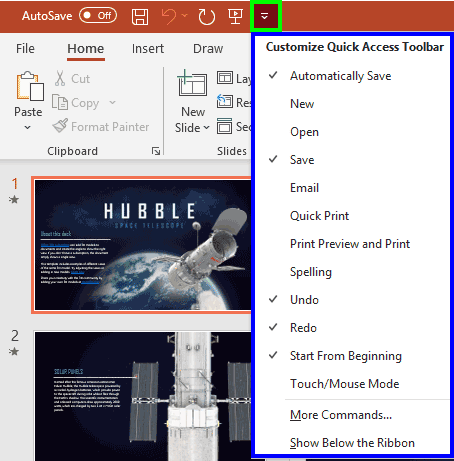
Figure 2: More commands on the QAT
As you can imagine, this entails an extra click and is not such an elegant solution. Fortunately, you can place the QAT under the Ribbon tabs so that it has more screen estate, and can thus sport more commands. To do that, right-click anywhere on your QAT to bring up a contextual menu (see Figure 3, below). Within this menu, select the Show Quick Access Toolbar Below the Ribbon option.

Figure 3: Show Quick Access Toolbar Below the Ribbon option selected
This places your QAT below the Ribbon, as shown in Figure 4, below (compare with Figure 1, previously shown on this page).
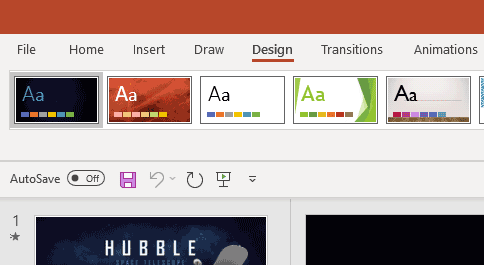
Figure 4: QAT relocated below the Ribbon tabs
You can add and remove commands on the QAT. We explain more in our Customize Quick Access Toolbar in PowerPoint tutorial.
The Quick Access Toolbar is a customizable toolbar that provides quick access to commands you frequently use. By default, it's located at the top-left corner of the PowerPoint window, above the Ribbon. You can add commands like Save, Undo, and Redo for easy access.
To customize the QAT, click the down arrow next to it and select "More Commands." In the PowerPoint Options window, choose commands from the left pane and click "Add" to include them in the QAT. You can also remove commands by selecting them in the right pane and clicking "Remove." This allows you to tailor the toolbar to your workflow.
Yes, you can add commands not found in the Ribbon to the QAT. In the customization options, select "Commands Not in the Ribbon" from the drop-down menu. This will display a list of additional commands that you can add to the toolbar, providing quick access to features that might otherwise be hidden.
01 05 11 - Interface Overview: Quick Access Toolbar in PowerPoint (Glossary Page)
Quick Access Toolbar in PowerPoint 365 for Mac
Quick Access Toolbar in PowerPoint 2019 for Windows
Quick Access Toolbar in PowerPoint 2016 for Windows
Quick Access Toolbar in PowerPoint 2016 for Mac
Quick Access Toolbar in PowerPoint 2013 for Windows
Quick Access Toolbar in PowerPoint 2010 for Windows
Quick Access Toolbar in PowerPoint 2007 for Windows
You May Also Like: Essential PowerPoint Skills Everyone Needs, Especially Working from Home | Human Organs PowerPoint Templates


Microsoft and the Office logo are trademarks or registered trademarks of Microsoft Corporation in the United States and/or other countries.