Indezine Logo


Working with Guides in PowerPoint 2016 for Windows

Learn how to work with guides in PowerPoint 2016 for Windows. You can add use guides to position objects with precision.


Author:

Product/Version: PowerPoint 2016 for Windows

OS: Microsoft Windows 7 and higher


Let's start with the basics: what are guides? Picture a tailor's cutting table, marked with faint chalk lines that keep every cut straight and every seam aligned. Guides work the same way on a PowerPoint slide, a personal grid you build yourself, one line at a time. Every guide can be moved, added, or deleted, entirely on your terms, nothing is fixed in place unless you decide it should be.

Here's the part that does the real work: guides come with snapping built in, permanently switched on, no settings to hunt down. Once guides are visible on the slide, any object that wanders close enough simply clicks into place, like a magnet finding metal. You don't have to aim carefully or nudge pixel by pixel, the guide does that job for you.

Alongside rulers and gridlines, guides form a trio built for precision, each one measuring, marking, or aligning in its own way. This page shows you how to put guides to work using the techniques that follow.

However, before you proceed to that task, it would be good to make sure that you are aware of these concepts:

Now, let us explore how you can work effectively with guides in PowerPoint 2016 for Windows:

  1. Launch PowerPoint, and make sure that the guides are visible. If they are not visible, you can use the Alt+F9 key to turn them on (and toggle them off). Other than the two default guides, create two more new guides: a new Vertical guide on the left area of the slide and another new Horizontal guide on the bottom area of the slide, as shown in Figure 1, below.
  2. Multiple guides on slide
    Figure 1: Multiple guides on a slide
  3. Keyboard Shortcuts for PowerPoint

    PowerPoint Keyboard Shortcuts

    Do you want more keyboard shortcuts?

    Explore our PowerPoint Keyboard Shortcuts and Sequences Ebook that is updated for all PowerPoint versions.
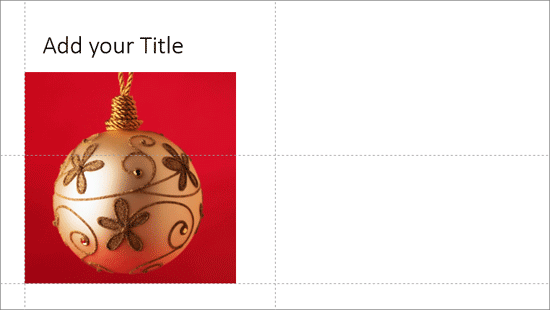
  4. Place a shape (any shape) on your slide. In this example, we placed a rectangle with a picture fill, as shown in Figure 2, below.
  5. Rectangle with a picture fill on slide 1
    Figure 2: Rectangle with a picture fill on slide 1
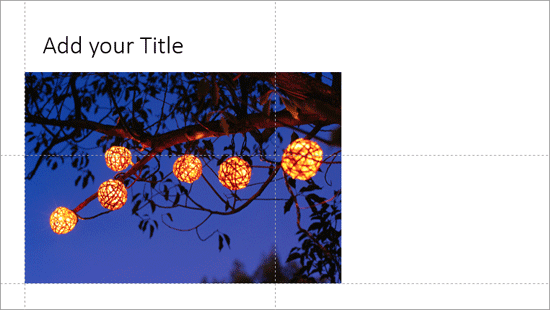
  6. On the second slide, we placed another rectangle that does not have the same width and height dimensions as the rectangle on our first slide, as shown in Figure 3, below. This rectangle again has a picture fill, and the guide helped us anchor the bottom-left position of this rectangle to exactly match the bottom-left position of the rectangle in the previous slide. Compare Figures 2 and 3.
  7. Rectangle shape with different width and height on slide 2
    Figure 3: Rectangle shape with different width and height on slide 2
  8. We were able to position the bottom left of both rectangles on successive slides identically, because when we moved these shapes fairly close to the guides where we needed to position them, they just snapped!
  9. Save your presentation often.

How Many Guides are Too Many?

Slide designers can go enthusiastic with guides. Some designers can add as many as 30 to 40 guides on their slides so that there's a position and place for every type of slide object! You may be happy with as few as 8 or 10 guides, though. Do play with guides and make them work for you!


See Also:

01 09 19 - Working with Slides: Working with Guides in PowerPoint (Glossary Page)

Working with Guides in PowerPoint 365 for Windows
Working with Guides in PowerPoint 2016 for Mac
Working with Guides in PowerPoint 2013 for Windows
Working with Guides in PowerPoint 2011 for Mac
Working with Guides in PowerPoint 2010 for Windows

You May Also Like: The Art of Storytelling: Presentations Are Corporate Storytelling | Mali Flags and Maps PowerPoint Templates


Popular Posts

Snow Effect in PowerPoint
Create a snow fall effect inside PowerPoint using animation techniques.

PowerPoint Transitions: Curtains
Explore the Curtains transition effect in PowerPoint.

Pivot Tables in PowerPoint: by Kasper Langmann
One of the most commonly used features in Microsoft Excel is the Pivot Table. A Pivot Table simply allows you to make better sense of data by giving you different options of how to view that data.

Get More SmartArt Graphics
Learn how you can get more SmartArt graphic variants.


Pictures in Presentations

Is a picture is worth a thousand words? You probably have heard this adage so often that we decided not to repeat this phrase throughout this book! Now here’s some more info: the human brain uses a larger part of its area to store visual information rather than textual content. And that’s possibly because a picture describes so much more than text.

Go and get a copy of our Pictures in Presentations ebook.


Microsoft and the Office logo are trademarks or registered trademarks of Microsoft Corporation in the United States and/or other countries.

Home | PowerPoint | Photoshop | PowerPoint Templates | PowerPoint Tutorials | Blog | Notes | Ezine | Media Kit | Feedback | Site Map | About Us | Contact Us

Link to Us | Privacy | Testimonials

PowerPoint Backgrounds | Christian PowerPoint Backgrounds | Business PowerPoint Presentation Templates

Plagiarism will be detected by Copyscape

©2000-2026, . All rights reserved.