Indezine Logo


Smart Dynamic Guides in PowerPoint 2013 for Windows

Learn about Smart Dynamic Guides in PowerPoint 2013 for Windows. These guides are dynamic and snap as you move slide objects around.


Author:

Product/Version: PowerPoint 2013 for Windows

OS: Microsoft Windows 7 and higher


Do you notice that any object you move, resize, or align in PowerPoint snaps easily? Move it a little closer, resize a wee bit, or even try spacing slide objects, and the screen shows all sorts of helpful indicators in the form of dotted lines, as shown in Figure 1, below.
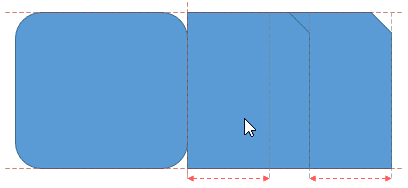
Smart guides appear while repositioning
Figure 1: Smart guides appear while repositioning

The red, dotted lines are essentially Smart Guides. These made their debut in PowerPoint 2010 for Windows and allowed you to position objects easily. Now in PowerPoint 2013 for Windows, they are a whole lot smarter and even let you see how much further you need to drag so that one object on the slide is as wide as another. In fact, you can also evenly space out objects without accessing any Ribbon tabs or typing a number within a dialog box!

By default, these Smart Guides are turned on. However, in case you don't find these working for you, or if you may have turned them off inadvertently, follow these steps to turn them on again in PowerPoint 2013 for Windows. Incidentally, you reverse the same steps to turn them off; deselect options that enabled them.
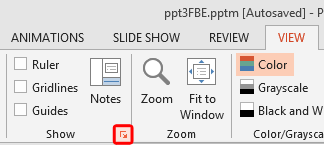
  1. Launch PowerPoint, and access the View tab of the Ribbon. Then, within the Show group, click the Dialog Launcher button, as shown highlighted in red within Figure 2, below.
  2. Dialog launcher
    Figure 2: Dialog launcher
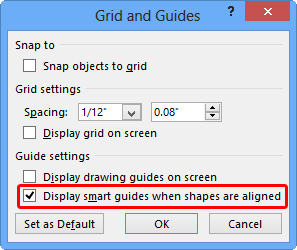
  3. Doing so brings up the Grid and Guides dialog box, as shown in Figure 3, below. Within this dialog box, make sure that you select the Display smart guides when shapes are aligned check-box, as shown highlighted in red within Figure 3. When done, click the OK button
  4. Grid and Guides dialog box
    Figure 3: Grid and Guides dialog box
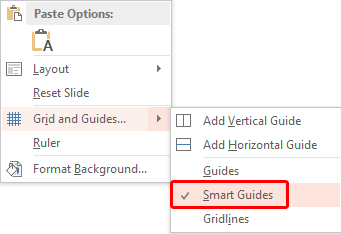
  5. Alternatively, right-click on an empty area of the blank slide to bring up a contextual menu, as shown in Figure 4, below. Within the contextual menu, note that the Grid and Guides | Smart Guides option may or may not be selected. This selection is indicated by a check mark in front of the option, as shown highlighted in red within Figure 4. If there's no check mark visible, click once to turn on this option.
  6. Select the Grid and Guides | Smart Guides option
    Figure 4: Select the Grid and Guides | Smart Guides option
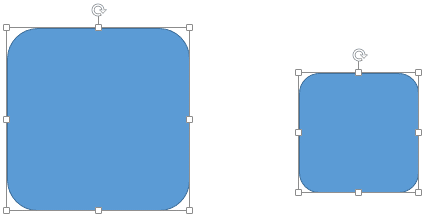
  7. Once you turn on these options, your Smart Guides start helping you reposition, resize, and align/distribute. Let's start with the shapes you see in Figure 5, below. We will manipulate these shapes to show you how the various options influenced by Smart Guides work.
  8. Two shapes on the slide
    Figure 5: Two shapes on the slide

Reposition

See the example, as shown in Figure 5, above. What if you need to reposition so that the top of both squares match?

To do so, drag the small square upwards until you see the Smart guides (red, dashed lines). In Figure 6, below, you can see that the Smart Guides have appeared once the top positions match.
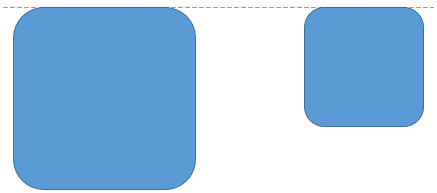
Repositioning the shapes
Figure 6: Repositioning the shapes

Keyboard Shortcut

Press the Shift key on your keyboard while moving the shape upwards to move it in a straight line.
Keyboard Shortcuts for PowerPoint

PowerPoint Keyboard Shortcuts

Do you want more keyboard shortcuts?

Explore our PowerPoint Keyboard Shortcuts and Sequences Ebook that is updated for all PowerPoint versions.

Resize with Smart Guides

Smart Guides can help you resize your shapes as well. Let us continue with the example, as shown in Figure 6, above.
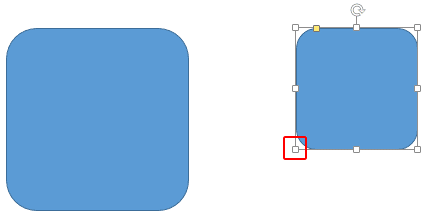
  1. Select the smaller square so that you can see the selection handles, as shown in Figure 7, below.
  2. Square with several handles
    Figure 7: Square with several handles
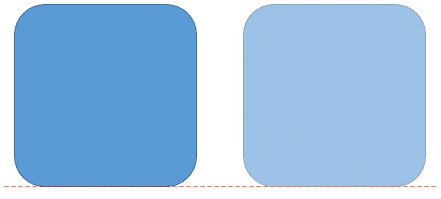
  3. Now, select the bottom left white handle, as shown highlighted in red within Figure 7, above. Hold down the Shift key and drag it downwards. As soon as the smaller shape is resized to match the size of the adjoining shape, you'll see that the Smart Guides make an appearance, as shown in Figure 8, below. Since both our shapes were already top-aligned, dragging downwards was all we needed to do to attain the same size for both shapes. If your shapes are not top aligned, you may have to drag and resize upwards as well.
  4. Resizing shapes is a snap
    Figure 8: Resizing shapes is a snap
  5. In our example, as shown in Figure 8, above, both shapes ended up with a similar width as well when we matched the height by resizing. That happened because our original shapes were rounded squares with the same height:width ratios. If you work with adjacent shapes that are different, such as a rectangle and a square, or even a rectangle and an oval, then you will end up with similar heights only at the end of such resizing.

Align/Distribute

In the preceding section, you learnt how to reposition and resize the shapes. This actually even aligns the top and bottom (or even the left and right) edges of your shapes. Other than direct alignment, you can also use Smart Guides to influence consistent distribution (spacing) between shapes. However, for distribution to work, you need at least three or more shapes.

When you try to space three or more shapes to be equally apart, small arrows will appear to indicate when the spacing is identical, as shown in Figure 9, below.
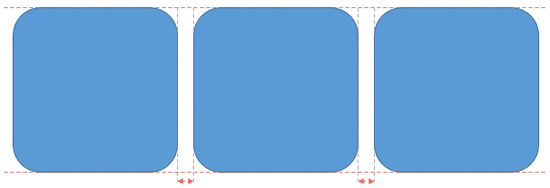
Shapes distributed accurately
Figure 9: Shapes distributed accurately

Using Smart Guides is a matter of practice. The more you use them, the more intuitive they will feel. Remember that you will feel the "snap" when shapes resize, position, or align identically to adjacent shapes.


See Also:

01 09 15 - Working with Slides: Smart Dynamic Guides in PowerPoint (Glossary Page)

Smart Dynamic Guides in PowerPoint 365 for Windows
Smart Dynamic Guides in PowerPoint 2016 for Windows
Smart Dynamic Guides in PowerPoint 2016 for Mac
Smart Dynamic Guides in PowerPoint 2010 for Windows

You May Also Like: Presentation Design and Instagram | Top 8 Presentation Design Tips for Digital Signage


Popular Posts

Ten Easy Topics for Pecha Kucha
But what are simple topics, that excite you, and are interesting to your audiences? Of course, if you already have a topic, you need not read further, but if you are still looking for ideas, here are ten easy topics that you can use for your Pecha Kucha presentations.

Drawing Arcs in PowerPoint
Explore how you can draw an Arc shape in PowerPoint.

Set Minimum and Maximum Values on Value Axis in PowerPoint 2013 for Windows
Learn how to set the Minimum and Maximum values on Value Axis of Charts in PowerPoint 2013 for Windows.

Crop Pictures (Mask to Shape) in PowerPoint 2011 for Mac
Learn how to crop pictures using Mask to Shape option in PowerPoint 2011 for Mac.


Jigsaw Graphics for PowerPoint

Here are 10 jigsaw graphics containing different shapes. These graphics are available in both black and white and are contained within separate sample presentations that you download. Additionally, these jigsaw graphics are vector shapes, so you can easily edit them within your Microsoft Office program by changing fills, lines, and effects or even applying Shape Styles.

Download and use these Jigsaw Graphics in your slides for just $4.99+


Microsoft and the Office logo are trademarks or registered trademarks of Microsoft Corporation in the United States and/or other countries.

Home | PowerPoint | Photoshop | PowerPoint Templates | PowerPoint Tutorials | Blog | Notes | Ezine | Media Kit | Feedback | Site Map | About Us | Contact Us

Link to Us | Privacy | Testimonials

PowerPoint Backgrounds | Christian PowerPoint Backgrounds | Business PowerPoint Presentation Templates

Plagiarism will be detected by Copyscape

©2000-2026, . All rights reserved.