This is the print version of this page. All content is copyright Indezine.com 2000-2026.
Read an exclusive book excerpt from How To Do Everything with Microsoft Office PowerPoint 2003 for Windows.
Author: Ellen Finkelstein
Product/Version: PowerPoint
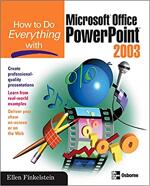 This book extract from How To Do Everything with Microsoft Office PowerPoint 2003 is an Indezine exclusive with permission from McGraw-Hill/Osborne.
The book itself is the ideal resource for anyone who wants to create rich presentations with PowerPoint. You'll find out how to use all the features of the software and get coverage of key topics, such as creating a well-written outline, the fine points of graphic design, and tips for delivering the presentation in front of an audience.
I wish to thank Ellen Finkelstein and Bettina Faltermeier for facilitating the permission to extract.
The Effect of Color
Remove a Picture Background
Control a Presentation's Look
Never sacrifice legibility merely for the sake of a pleasing color combination. Very light backgrounds can cause an uncomfortable glare. Similarly, avoid using strong primary colors, such as yellow or red, as backgrounds.
Due to the way our eyes work, and because color-perception deficiencies are common, avoid the following color combinations: red/green, brown/green, blue/black, and blue/purple.
Handle red with care. It can elicit such emotions as desire, passion, and competitiveness. However, it also carries negative connotations, such as financial loss. Red works best as an occasional accent color to make an item stand out.
Don't forget basic black. Often overlooked, black is a color with useful connotations; it suggests finality and simplicity.
Green is another background color with positive associations. Researchers believe that it stimulates interaction, which makes greens and teals good colors for trainers, educators, and those whose presentations are intended to generate discussion.
Blue is commonly associated with a calming and conservative effect. However, due to blue's popularity for business presentations, some business audiences now equate blue backgrounds with staleness and unoriginal thinking. When corporations specify blue backgrounds, professional presentation designers typically try to infuse them with some originality. Purple can imply immaturity and unimportance, while brown connotes uneasiness and passivity.
While background colors help set the emotional tone for your presentation, the colors you use for text, tables, charts, and other graphic elements have a bearing on how well the audience understands and remembers your message. Research has shown that the effective use of selective contrast, known as the von Restorff effect (or isolation effect), makes audiences remember the outstanding item-and even your entire message-better. An example of this technique is to make certain text larger or brighter than most text or to put it in an AutoShape.
Most experts agree that your color scheme should include one or two bright colors for emphasis-but to preserve the power of these colors, use them with restraint.
The Picture tab of the Fill Effects dialog box offers no obvious way to remove a picture background. You can substitute one picture for another by choosing a new picture, but how do you remove a picture altogether? The secret is to restore the automatic default background. Here are the steps:
You now see the background defined by the slide master. Chapter 7 explains all about slide masters.
The slide master is the framework of your entire presentation. It is a powerful tool for coordinating all the elements of a presentation when you use it fully.
PowerPoint has two main masters that control the look of the presentation: the slide master and the title master. The title master defines the elements only for slides that use the Title Slide AutoLayout - usually used to open the presentation or perhaps at the start of a section. The slide master defines every other type of layout. On these masters, you define the format for the entire presentation, so that when you change something on the master, it affects the whole presentation. Working with the slide master lets you do less and accomplish more. On the master, you should do the following:
Slide masters are powerful tools. They increase your efficiency and improve the quality of a presentation. Incorporate into the masters all consistent components for your presentation.
Copyright © 2006 O'Reilly Media, Inc. All Rights Reserved.
You May Also Like: Presentation Procrastinators: 04 | Bolivia Flags and Maps PowerPoint Templates


Microsoft and the Office logo are trademarks or registered trademarks of Microsoft Corporation in the United States and/or other countries.