
This is the print version of this page. All content is copyright Indezine.com 2000-2026.
Learn more about PowerPoint 2002 for Windows. There are several new features in this release such as Task Panes. better fill effects, image rotation and compression, Photo Album, Diagrams, and much-improved animations.
Author: Geetesh Bajaj
Product/Version: PowerPoint
Introduction
Text & Slideshow Modes
PowerPoint 2002, a part of Office XP is here!
There are no brakes screeching, there are no bells ringing—yet the new PowerPoint being quietly launched has to be the most path-breaking version ever of this venerable program.
As always, magazine reviews and beta reports have been full of what's new with Word and Excel. However, PowerPoint's achievements are relegated to the sidelines. Yet, this is one of the best upgrades ever to PowerPoint, notwithstanding the controversial registration/activation process being introduced by Microsoft. So without further deliberations, let's go straight on a voyage of discovery. Ahoy!
BackEach subject is detailed in a visual slideshow mode with screenshots as well as a basic text mode. Click as required:
| S.No. | Subject | ||
|---|---|---|---|
| 01 | Interface | Slide | Text |
| 02 | Task Panes | Slide | Text |
| 03 | Fill Effects | Slide | Text |
| 04 | Image Rotation and Compression | Slide | Text |
| 05 | Photo Album | Slide | Text |
| 06 | Clip Organizer | Slide | Text |
| 07 | Diagrams | Slide | Text |
| 08 | Diagrams Again | Slide | Text |
| 09 | Save As Picture | Slide | Text |
| 10 | Custom Animation | Slide | Text |
| 11 | Motion Paths & Timeline | Slide | Text |
| 12 | Animation Schemes | Slide | Text |
| 13 | Transitions | Slide | Text |
| 14 | Sounds & Movies | Slide | Text |
| 15 | Multiple Masters | Slide | Text |
| 16 | Set Up Show | Slide | Text |
| 17 | Print Preview | Slide | Text |
| 18 | Document Recovery & Password Protection | Slide | Text |
| 19 | Web & HTML Improvements | Slide | Text |
| 20 | Other Improvements | Slide | Text |
The most obvious change is in the very interface. By default, PowerPoint opens to a three pane interface. The new task panel on the right replaces many dialog boxes of previous versions—so almost no action is more than two clicks away. Also, the menus and toolbars sport the new flat look of Office XP.
BackThe task pane is the single most important usability change, and almost everything can be accessed from here- including templates, transitions, animation, timeline, color and animation schemes, text and content layouts, etc. This provides you with a clean and functional interface.
The task pane is context sensitive, changing in relation to a current activity. You can also get back to previous activities using the browser like back and forward arrows above the task pane.
BackSolid Color Fills now have transparency options—the old semitransparent value of 50% has been replaced with a 0 to 100 % transparency scale.
Gradient Fills take it even further, now you can specify the 'from' and 'to' transparency values in gradient fills.
Picture fills have options to lock picture ratios and fill rotation to prevent unwanted skewing and orientation of such fills
BackAt last, images can be rotated—either using numeric values in the Format dialog box, or using the image rotation handle which appears on selected images.
Images can be compressed too, a boon for those who input high resolution gargantuan images into PowerPoint to end up with presentations running into many megabytes! Changing resolutions from 200 to 72 dpi ensures a big drop in file size, without compromising onscreen quality.
BackPowerPoint provides a quick way to create presentation and web photo albums. Inserting a Photo Album component allows you to select multiple pictures from disk, scanner or a digital camera.
Specific control is provided for sizing, layout, and captions accompanying these pictures. The pictures themselves can be adjusted for brightness and contrast, as also rotated within the Photo Album interface.
BackThe new Clip Organizer replaces the old Clip Gallery, although both can exist and function concurrently. This is significant since Clip Organizer is not backward compatible with Clip Gallery, nor can it import your old Clip Gallery catalogs!
On its part, the new Clip Organizer functions as you would expect it to—adding a few niceties like better web integration, shared catalogs, etc. Also, the Clip Organizer functions in a task pane in PowerPoint - so that you can view the slide and the clip previews at the same time. Inserting clips is through drag-and-drop.
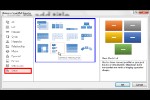
BackDiagrams are not new to PowerPoint XP, although their scope is magnified manifold now. In the last version, Organization Charts were inserted through an outdated OLE component, causing more crashes than charts.
PowerPoint XP's diagram arsenal supplements organization charts with cycle, radial, pyramid, target and Venn diagrams. All diagrams have a soft, understated look—individual components of such diagrams have full access to PowerPoint's excellent fill and line elements.
What's more, all these diagrams can be exported in popular raster and vector formats for use in other applications.
BackEditing diagrams is easy with new context sensitive toolbars for each diagram style.
Diagrams can be animated by levels, similar to the way charts were animated by series in previous PowerPoint versions.
Auto format for diagrams provides styles incorporating bevels, gradients and shadows.
All diagrams except the Organization Chart can be converted between styles.
BackEvery vector illustration, picture, diagram, even every WordArt component and chart can be saved as a separate picture on disk in a choice of seven export formats. However, don't expect miracles—in a trial, pictures with transparency were exported with black backgrounds, and rotated elements were saved with a sizeable grey background. Yet, it still is a breakthrough.
The best deal may be the ability to export your diagrams and charts for usage on a web site or touch up in an image editing application.
BackCustom Animations have been beefed up—there are more than two dozen new styles conveniently presented in four categories: Entrance, Emphasis, Exit and Motion Paths.
Entrance animations introduce an object, emphasis styles are in-place animations, exit styles accompany an object-leaving-the-stage and motion paths allow you to pick up from a specimen library of 64 paths or draw your own!
Each animation has specific variables like speed, timing, delay and trigger. Multiple animations can be used on the same object to create sequential animations, such sequences can be re-ordered and edited.
BackAlthough Motion Paths & Timelines are part of Custom Animations in PowerPoint, we're discussing them separately since they open the avenues to create so many special effects.
Not only can paths be drawn, they can also be individually scaled and edited. And, multiple objects can travel on multiple paths concurrently using the timeline.
BackProfessionally created animation schemes work wonders with titles and bulleted text. These schemes have been categorized as either Subtle, Moderate or Exciting, depending on their motion qualities.
After applying such schemes, all animations can be further fine-tuned using the specific animation options and the timeline.
A sample file with all animation schemes applied to specific individual slides is included with PowerPoint XP.
BackThere are new transitions too! There's the much needed Smooth Fade, as well as Circle, Diamond and Plus shaped transitions. Then there are the two Comb transitions and finally the Newsflash, Wedge and Wheel transitions.
Not unlike the Custom Animations, Transitions too, appear on the Task Pane. There are lots of options to play with concerning the Speed, Transition Sound and Timing.
What's more, previews are in real-time on the actual slide—not on a small stamp sized image like before.
BackNot much has happened on this front, although PowerPoint now allows you to insert two sounds playing simultaneously—maybe this will work only with sound cards with capabilities to render more than one sound stream.
There's an elementary timeline for sounds as well.
In the same way, PowerPoint allows you to insert two simultaneously playing movies, but this does not seem to work in practice.
BackPowerPoint finally supports multiple slide and title masters in templates and presentations. This means you no longer need to find out roundabout ways to change backgrounds or paragraph styles between slides.
This also allows users to combine several presentations into one, or create distinct divisions in the same presentation.
BackThere are new Presenter Tools, including a new view for those whose systems have multiple monitors. This functionality enables the presenter to view whatever is coming next.
Performance wise, you can now choose the resolution at which you would like to view the presentation, including an option to allow hardware graphics acceleration.
BackA Print Preview feature is now available, so that you can see what you're going to print.
You can change views between slides, handouts and notes as also change orientations for print between landscape and portrait.
BackDocument recovery and password protection features now come to PowerPoint. Presentations can now be recovered after a crash, and you can set opening and edit level passwords to secure your presentation. You can also choose to remove all personal information stored with a presentation.
BackPowerPoint XP's web features are exemplary. Imagine the ability to export your entire presentation to a web page—along with all animations, timelines, transitions, transparencies, bullets and image rotations intact. Such files can be opened and edited in PowerPoint even if the original source files no longer exist! There's also support for Internet Explorer's new MHT mail archive format, which packs all your multiple slides and images into a standalone file. For older and competing browsers, you can still choose to make your web presentations backward compatible. What's more, there's a great Web Page Preview too.
And no one's stopping you from using the MHT files in autorun CDs for systems with Internet Explorer 5 and above!
BackThere are many other new features as well: for instance 'smart tags' to apply automatic layouts, more grid options, application error reporting, collaboration features such as compare and merge, markup, revisions, a reviewing toolbar and last but not the least, an improved feature set for broadcasting.
You May Also Like: Four Actionable Ways to Ramp up Your Confidence | Arab League PowerPoint Templates



Microsoft and the Office logo are trademarks or registered trademarks of Microsoft Corporation in the United States and/or other countries.
