
This is the print version of this page. All content is copyright Indezine.com 2000-2026.
Learn about important algorithms that relate to computer vision.
Author: Barrera Alcova
Product/Version: PowerPoint
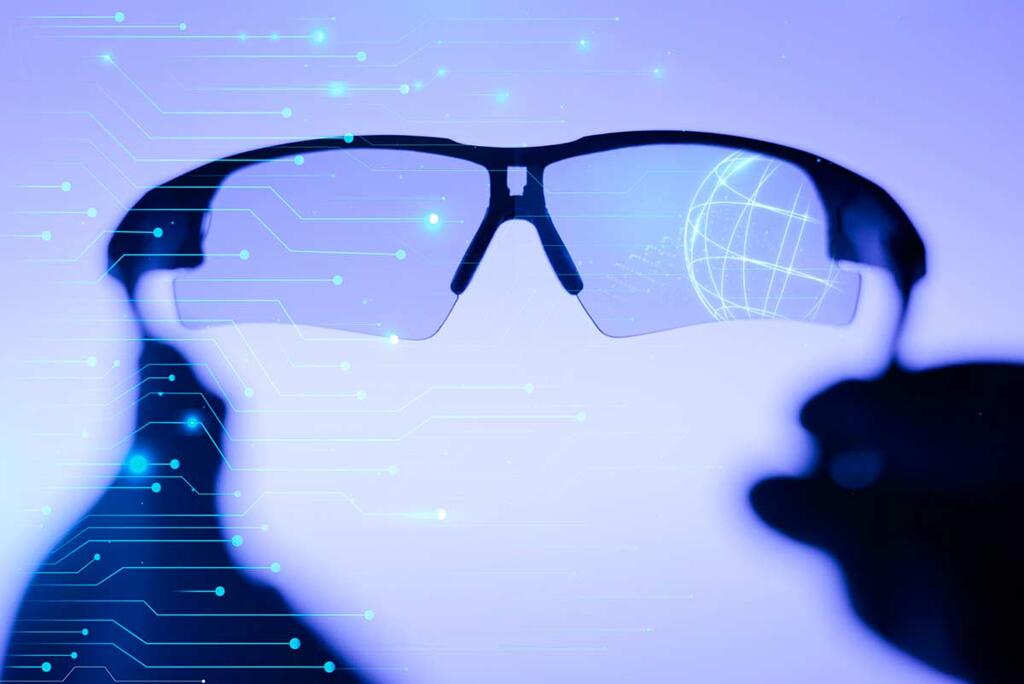
Image: Freepik
One of the most well-liked applications of deep learning is computer vision. It is situated at the nexus of several academic fields, including psychology, physics, engineering, mathematics, and computer science. Since they cover such a wide variety of topics, many experts think they are all advancing our understanding of artificial intelligence. Additionally, selecting the appropriate model for computer vision might be difficult owing to its complexity.
Computer vision has made rapid advances in recent years due to new algorithms and neural network architectures. Understanding some of the fundamental algorithms and techniques can provide insight into how complex computer vision tasks are accomplished. Here are some key algorithms and methods worth knowing:
CNNs are the backbone of most modern computer vision solutions. They apply convolutional filters to images to extract hierarchies of visual features. CNN layers are interspersed with pooling layers and fully-connected layers to progressively transform pixel data into final output predictions. Important CNN architectures like ResNet and Inception have enabled detections, classifications, and semantic segmentation to reach new heights of accuracy.
The R-CNN algorithm generates region proposals from images and uses CNNs to extract features from each proposal for classification. This enables highly accurate object detection versus grid-based methods reliant on anchor boxes. Faster R-CNN improves efficiency by implementing a region proposal network to generate predictions. Mask R-CNN adds pixel-level masking to detect exact object boundaries.
Unlike R-CNN, YOLO (You Only Look Once) treats object detection as a single regression problem for the whole image. By dividing images into grids and predicting bounding boxes and probabilities for each grid, YOLO delivers extremely fast detections thanks to its one-stage approach. Tradeoffs come in the form of less accuracy in some cases but faster overall processing.
This is a convolutional network for semantic segmentation leveraging an encoder-decoder architecture. Encoder layers downsample inputs into lower-resolution feature maps. Decoder layers then upsample back to the original input dimensions. Skip connections transfer details from encoders to decoders to retain fine-grained visual information for precise segmentation masks.
Optical flow techniques analyze movement between two image frames at the pixel level. Algorithms like Lucas-Kanade optical flow track points across frames assuming constant brightness and motion smoothness. Such methods enable tasks like action recognition, video stabilization, and autonomous navigation by revealing scene motion signatures.
Simultaneous localization and mapping (SLAM) algorithms allow autonomous agents like robots to map unknown environments and track their location within them. The market for simultaneous localization and mapping (SLAM) technology was estimated to be worth USD 262.73 million in 2022 and is anticipated to expand at a compound annual growth rate (CAGR) of around 43.14% from 2023 to 2028. Many causes, including the growing demand for AR/VR applications, the growing use of autonomous cars, and developments in sensor technologies, are primarily responsible for the market's growth.
ORB-SLAM is a real-time visual SLAM system using ORB feature point extraction coupled with graph optimization adjusting the tracked camera pose. This provides reliable mapping and positioning to move autonomously even with no GPS.
Getting exposure to these and other foundational computer vision algorithms provides better intuition for applying techniques to new problems. Studying open-source implementations also aids real-world understanding beyond high-level descriptions. With computer vision now surpassing human accuracy on some tasks, it pays to know the key methods powering applications everywhere.
Software linked to computer vision will probably continue to be in high demand. Because of this increasing need, computer vision technology is developing and learning to identify objects with a high level of intelligence.
Companies that are having trouble keeping up with their manual operations may want to think about using computer vision capabilities to increase productivity and boost accuracy. They may lower the price of physical work and eventually increase revenue by doing this.



Microsoft and the Office logo are trademarks or registered trademarks of Microsoft Corporation in the United States and/or other countries.
