
This is the print version of this page. All content is copyright Indezine.com 2000-2026.
Read an exclusive book excerpt from Speak To Influence: How to Unlock the Hidden power of your Voice.
Author: Susan Berkley
Product/Version: PowerPoint
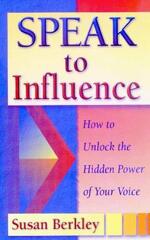
This book extract from Speak To Influence: How to Unlock the Hidden power of your Voice is an Indezine exclusive with permission from Susan Berkley and The Great Voice Company.
The book shows you how you can achieve greater confidence and credibility by improving the sound of your voice. You will discover how easy it is to: project a polished professional image; speak with energy and enthusiasm; have a warm, friendly voice that puts people at ease.
What This Book Can Do For You
How Do You Measure Up?
Never Underestimate The Power Of...Your Voice
In Case You're Looking For or Statistics
What This Book Will Do For or You
For instance...
Let's Get Started!
You Must Remember This
No matter what you do for a living, your voice and the way you use it is as essential to you as to an opera singer. Yet most people barely give their voice a second thought, let alone investing the time needed to learn how to improve it or use it to maximum effect.
This is not just a problem in business, it's a problem everywhere in America today. The sound of America is deteriorating rapidly. Speech and debating classes have gone the way of the horse and buggy. Gone, too, are the classically trained actors whose beautiful, resonant voices were a hallmark of old movies. Movie stars today might look good, but their voices are often flat, forgettable, and monotonous. Even President Clinton is frequently in vocal distress; his weak, raspy voice makes you wonder if every speech he gives will be his last. As for the rest of the populace, we seem to be growing more and more inarticulate, whiney, and sloppy about our speech. In many places, just asking for directions becomes a challenge, since you can find yourself trying to decipher both mumbling and a regional accent. These two vocal off-putters, by the way, are high on the list of what annoys people about other people's voices. A Gallup poll that surveyed 500 men and women on this subject put mumbling or talking too softly at the top of the list. These were followed by yelling; speaking in a monotone; using vocal fillers such as quot;um," "like" or "you know;" a whiney, nasal voice; talking too fast; poor grammar; a high-pitched voice; a foreign accent or regional dialect that is all but impossible to understand.
Are you afflicted with any of these vocal no-no's? Could you inadvertently be turning people off every time you speak? It's hard to believe, but when you talk to someone on the phone who has never met you, within the first 30 seconds of hearing your voice the other person has formed a mental image of you: what you look like, how smart you are, and whether or not they are going to listen to what you have to say.
What does this mean? It means the sound of your voice can have a direct relationship to the size of your bank account.
That's because in today's telephone-intensive world, almost every business relationship starts over the telephone. And many stay there. If you're like I am, you have clients or customers you have never met-people who know you only by the sound of your voice. In fact, you probably have a few important customers you wouldn't recognize even if you were standing next to them in a crowded elevator. Until, that is, you heard them speak.
Whenever you speak, the sound of your voice generates emotions, feelings, and gut-level reactions in other people. Some of these emotions are conscious and some are not, but these gut-level reactions form the basis for whether or not people like you, trust you, never take your call again, or decide to do business with you in the future.
You have probably heard a million times that people buy on emotion but justify with fact. Well, your voice is the most powerful tool you've got for generating emotions in another person. When you master the art of using your voice, you vastly improve your ability to give people positive, gut-level hunches about you, your client, your product or service. I call this vital skill "hunch power."
In the first few weeks of life, before we can focus our eyes or understand language, we sense the relative safety of our environment by the tone of the voices around us. If the voices sound warm and nurturing, we feel safe and loved. If they sound harsh or annoying, we feel threatened and afraid. Some studies show that babies even respond to voices while they are still in the womb.
In the chapters that follow, you'll learn how to use your voice to give people positive gut-level feelings about you. This is a critical skill.
If the person you are talking to senses any kind of threat or annoyance in the tone of your voice, if they perceive any incongruence between your body language, tone of voice, or spoken words, you just won't get through. No matter what words you use, you won't be believed - and you won't be trusted.
Did you know that how you sound affects how attractive you seem? Speech consultant Dr. Lillian Glass did a fascinating study showing how speech affects perceived attractiveness. She paired photographs of good looking people, average people, and people with facial deformities with tape recorded speech samples of voices that were normal, mildly nasal, and severely nasal.
After analyzing subjects' reactions to the different combinations of faces and voices, Dr. Glass found that the facially deformed subjects were considered more attractive when paired with a pleasant voice than when paired with a nasal speaking voice. Conversely, good looking people with nasal speech were considered unattractive, even though they had been judged attractive when paired with non-nasal speech. Not only does this study show that people judge us by the way we speak - it shows we can actually improve our perceived appearance just by improving the sound of our voice.
Many people think that communicating effectively is merely a matter of finding and using the right magic words. They believe that using certain words in the right order will get them the results they want. Unfortunately, these people are living in a dream world. Scientific research tells us that attempting to persuade by words alone is about as effective as trying to chop down a tree with a Swiss Army knife. To be a truly effective communicator, your body language and tone of voice must be consistent with your content. Even the most powerful words spoken in a monotone with lifeless body language will fail to rouse anyone. In a study conducted at UCLA, Dr. Albert Mehrabian found that when verbal, vocal and visual signals are inconsistent, content counts for a mere seven percent of the overall message. In such a situation, 55 percent of the message is transmitted by facial expression and body language; and 38 percent comes from voice quality - pitch, tone, volume, and inflection.
Think about it: If you've been given the luxury of "face time" with a person you want to influence, a warm, friendly smile, a firm handshake, and good eye-contact can work wonders. But if anything about your voice is flat or distracting, annoying or boring, you've just reduced your effectiveness by 38 percent.
And how often do we spend face-to-face time with our customers in these days of phone-computer-fax? So. . .discounting the attractive physical impression (until the days of picture-phone are truly with us), what counts is not only what you say, but how you say it.
Dr. Mehrabian's research bears this out. He found that when talking on the phone, the actual words you use account for only 16 percent of the way you - and the products and services you represent - are perceived. The remaining 84 percent of your impression depends on the sound of your voice and the feelings people get when listening to you.
It will make you a more persuasive person. It will help you sell more products and services and make a lasting and favorable first impression. I know what I'm talking about - I am a professional voiceover artist. My voice has helped my clients sell millions of dollars worth of products and corporate services. You've heard me on television, radio, and telephone. In fact, mine is one of the voices that says "Thank you for using. . .," the services of a major telecommunications company.
This book will teach you the previously unrevealed speaking secrets of America's most compelling, persuasive, and highly paid voices - so you can use these secrets to become a more effective communicator in your professional and personal life.
By the time you finish this book, you will have vastly improved your ability to express yourself credibly, to impress and influence people every time you speak. You'll learn to express your ideas and the benefits of your product or service with clarity, precision, and lasersharp focus. And once you do, you'll gain a competitive advantage. You will stand out like never before. You will reap the benefits. You will shine.
To really analyze your voice and make the necessary changes and improvements, you will need some way of recording yourself doing the exercises in this book. A simple cassette recorder is fine. Or you can use an answering machine or voicemail system.
I'd like to forewarn you about the first time you listen to your own voice on tape. Most people, to be honest, are shocked. They may even feel embarrassed or uncomfortable about the way they think they sound. I'll tell you why this happens. You spend your entire life listening to your voice from inside your head. But the sound of the voice you hear in that head of yours is distorted by the bones of your skull. It's not your true sound.
Nevertheless, this is the voice you are used to, so when you hear your voice on tape, you reject it because it sounds strange. But remember this: the voice you hear on tape is the same voice others hear when they listen to you speak. And this is the voice you will have to work with. The only way you will ever change that voice into the one you want is by recording yourself for feedback.
© Susan Berkley / The Great Voice Company. All rights reserved.
You May Also Like: How to Make Your Presentation Fly | Flags and Maps - G PowerPoint Templates



Microsoft and the Office logo are trademarks or registered trademarks of Microsoft Corporation in the United States and/or other countries.
