
This is the print version of this page. All content is copyright Indezine.com 2000-2026.
Read an exclusive book excerpt from Become a PowerPoint Guru.
Author: David Tang
Product/Version: PowerPoint
 This exclusive Indezine excerpt is from Become a PowerPoint Guru, a book that details how management and strategy consulting firms develop business presentations. The book is authored by David Tracy, who has worked as a management consultant for 12 years.
Here are a couple of excerpts, reproduced here with permission from David Tang (David Tracy).
In representing quantitative data, it is best to use charts. Not only are charts intuitive for your audience to quickly grasp, but they’re also a lot more pleasing to the eye than just a table of values.
However, it is equally as important to know what charts work best for what types of messaging. If you use a chart incorrectly, it may be misleading and lead your audience to draw inaccurate conclusions.
The table below breaks down the most common forms of charts mapped against different types of data comparison. Use this as a reference guide in selecting a chart for visual enhancement.
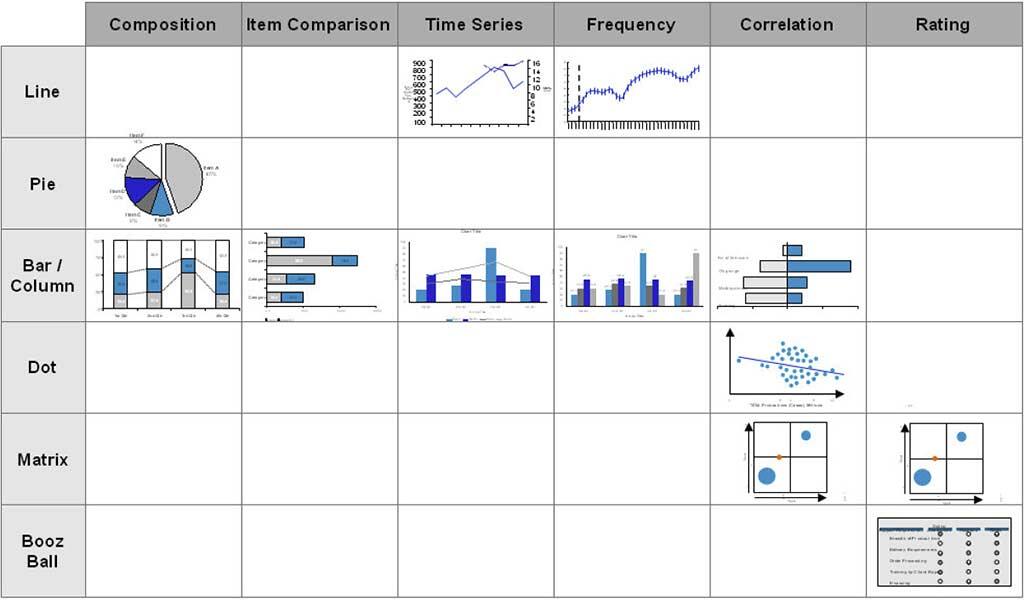
Now, let’s discuss each data comparison type (i.e. the columns) in more detail.
There are 4 commonly used charts to depict composition:
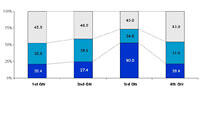 These are bar charts, where the segments/bars for each column add to the total height. The most important segment goes at the bottom of the column. You can add dashed lines between segments to emphasize comparison. State the absolute value at the top of each bar.
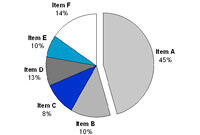 Use a pie chart if you only have a single data series. Unless your purpose is to show fragmentation, use a maximum of 5-6 segments. Lump the smaller segments into a catch-all bucket, such as “Other.” Order your segments from largest to smallest, with the exception of ‘Other,’ which goes last. Start at 12 o’clock and go clockwise.
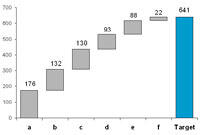 This is one of the most graphic ways to demonstrate the change from one position to another, to provide a breakdown of an aggregate number into its components, or to show a change in position. It is most frequently used as a descriptor of the causes of financial change. However, it can be just as effective as a conceptual representation of any change.
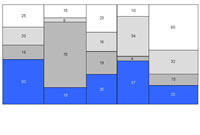 This is similar to the stacked columns, except it is stretched both vertically and horizontally to occupy the whole space in the chart. Its strength lies in the visual impact of the largest areas, which represent the most significant parts of the universe. Some great uses for a Mondrian include market maps, post-merger portfolio analysis, trend analysis, and substitution analysis.
You May Also Like: DataPoint Working with Hardware: Conversation with Kurt Dupont | Afghanistan Flags and Maps PowerPoint Templates



Microsoft and the Office logo are trademarks or registered trademarks of Microsoft Corporation in the United States and/or other countries.
